



tourism in alcalalí
The municipality of Alcalalí is located in the Pop Valley, in the Marina Alta region. Its municipal area is crossed by the river Gorgos and surrounded by the Seguili, Carrascal, Rates and Aixa mountains, forming a natural landscape of extraordinary beauty.
Our municipality offers the visitor a multitude of resources. Thus, you can find:

ACTIVO
ALCALALÍ

GASTRONOMIC
ALCALALÍ

CULTURAL
ALCALALÍ
ACTIVE ALCALALÍ
WALKING:
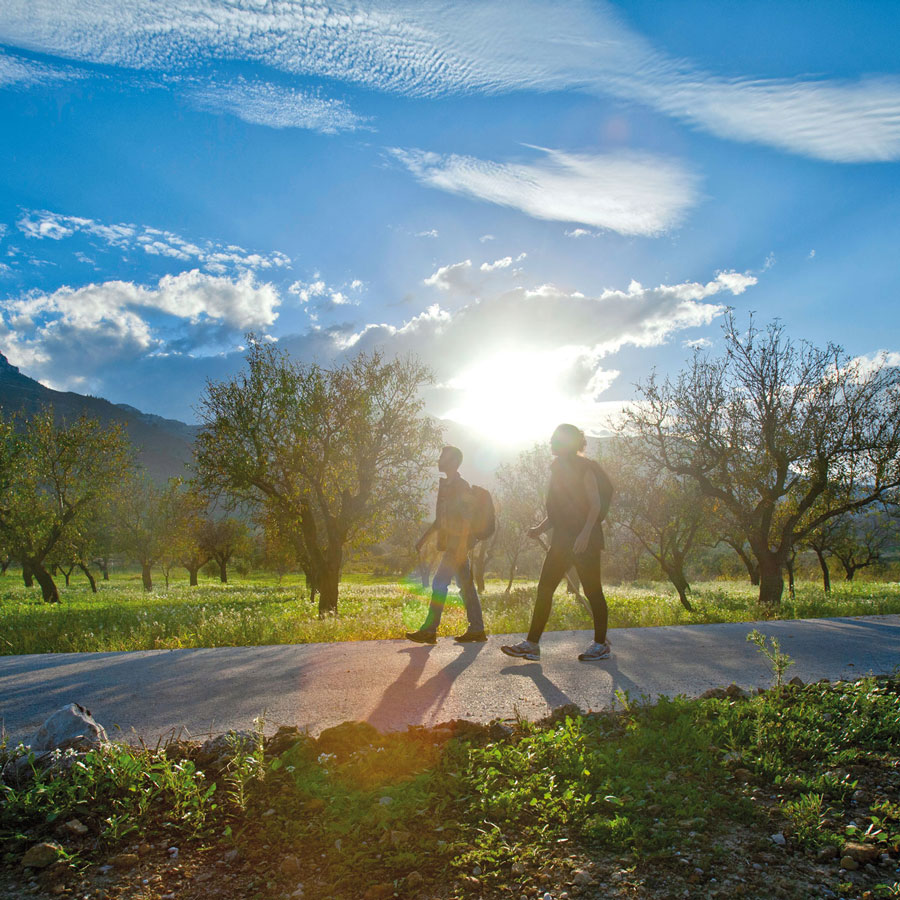
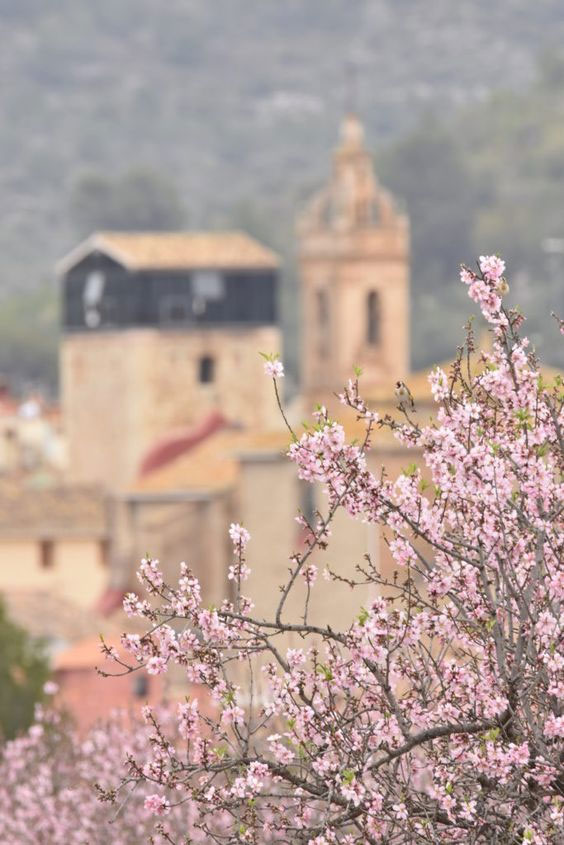
Our municipality is criss-crossed by a multitude of rural paths surrounded by almond and orange groves, which are a pleasure to walk along. During the month of February, when the almond trees are in bloom, our paths become a hustle and bustle of walkers.
You can get to know the municipal district of Alcalalí by following the Alcalalí - Coll de Rates hiking route.
This route is a great option for getting to know the cultural and scenic heritage of the municipality and the valley.
It is a circular route approved by the FEMEC and duly signposted, with a distance of 10,570 metres and a gradient of 395 metres.
It is estimated that it can be covered in approximately 3 hours and 40 minutes and the level of difficulty is medium-low.
Click here to download the information brochure.
Another proposed route that will allow you to delve into our history and heritage is the "Stone and Water" route. This is a linear route that runs along the Gorgos riverbed, declared a Site of Community Interest (SCI) and links the villages of the Pop Valley, from Benissa to Benigembla. This route highlights the architectural and hydraulic heritage of our villages and offers visitors unique landscapes.
In the information leaflet of the itinerary you can find more complete information.
We link you to other hiking routes that you can do:
Coll de Rates - Penya Talay - Els Massils - El Barranc del Negre: 8.28 km. Moderate
Cresta Sierra del Ferrer - Alcalalí: 15, 12 km. Difficult.
Route of the almond trees in blossom: 11.32 km. Easy.
CYCLING:
Cycling, both mountain biking and road cycling, is a very popular activity.
It is common to find groups of cyclists on the road up to Alcalalí.
The municipality has three signposted mountain bike routes of varying intensity.
The different routes proposed are suitable for both beginners and experts and their route allows you to discover the rich landscapes of our territory.
At the entrance to the municipality there is an information panel on the routes and it is at this point that the three routes start, all of which are circular in nature. You can download them by clicking here, as well as the tracks.
CULTURAL ALCALALÍ
MUSEUMS:
Parish Museum of Sant Joan de la Ribera: The museum houses exhibitions of paintings, sculptures, costumes, books, goldsmith's work, etc. Plaza Mayor (In the church itself), n º 4 Alcalalí. Tel: 96.648.00.43 - Mobile: 637.251.760
Ethnological Museum: Located in the old oil mill of Alcalalí. Both the machinery and the utensils used to make oil and wine have been restored. The museum gives us an insight into the daily work of the farmers of the time. The museum is located at 33 Porche Street.
HERITAGE ROUTE:
Alcalalí has important heritage resources that you can discover by following the marked route that starts in the centre of the municipality, specifically in the Town Hall square.
In this square you will find the Town Hall, built in 1984, the Medieval Tower from the 15th century, declared an Asset of Cultural Interest of the Spanish Historical Heritage and the Palace - Manor House of the Barons of Alcalalí, Ruiz de Lihori. In the centre of the Town Hall square, you can read the tiled mural installed on the façade of the Casa Abadia.
Continuing along the Calle Mayor, we reach the Calle Calvario and go up the Calle Valiente. In these narrow streets, we find the typical village houses, with huge entrance porticoes and beautiful interior courtyards.
Alcalalí, like the neighbouring villages of the Pop Valley, is one of the few places that still preserves intact one of the oldest sporting practices of the Valencian people: "La pelota valenciana". In Calvario street you can enjoy, some Saturday afternoons, a game of pelota. The most popular modality is "A Llargues", which can only be played in the street. At the end of Calle Valiente we find the Civic Centre surrounded by the Parque de la Cruz. From this location we can see the Seguili mountain and a multitude of terraces dedicated to the cultivation of almond trees, orange trees and vineyards. The park is equipped with leisure facilities for children.
Continuing the walk we continue along Calle Sequeret and Calle Parres. In this street we find the Mosquera Public School and the Cultural Centre. The houses still keep the typical structure, conserving the stone façades and in some of them we find details of Arabic architecture. Calle Parres ends at the Placeta Nova. This square was opened in 1950 and years later a stone and bronze monument dedicated to the Santísima Virgen del Calvario (Patron Saint of Alcalalí) was erected.
Leaving the square behind, we walk along Calle Solo and reach Calle Porxe. In this street is located the old oil mill which houses the Ethnological Museum dedicated to the process of elaboration of oil and wine. We continue our route along Ravalet street. Its name comes from the Valencian diminutive of the Arabic arrabado, which means "group of houses located at the end of the town". It was, and still is, the name given to the wide street that leads out of Alcalalí on the way to Mosquera. From this street we can see magnificent views of the valley, the Coll de Rates, a multitude of terraces, the Carrascal de Parcent and the River Gorgos.sa speech Lordship of the Barons of Alcalalí, Ruiz de Lihori. In the centre of the Town Hall square, you can read the tile mural installed on the façade of the Casa Abadía.
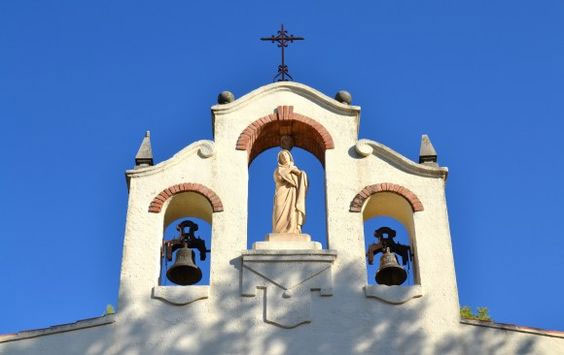
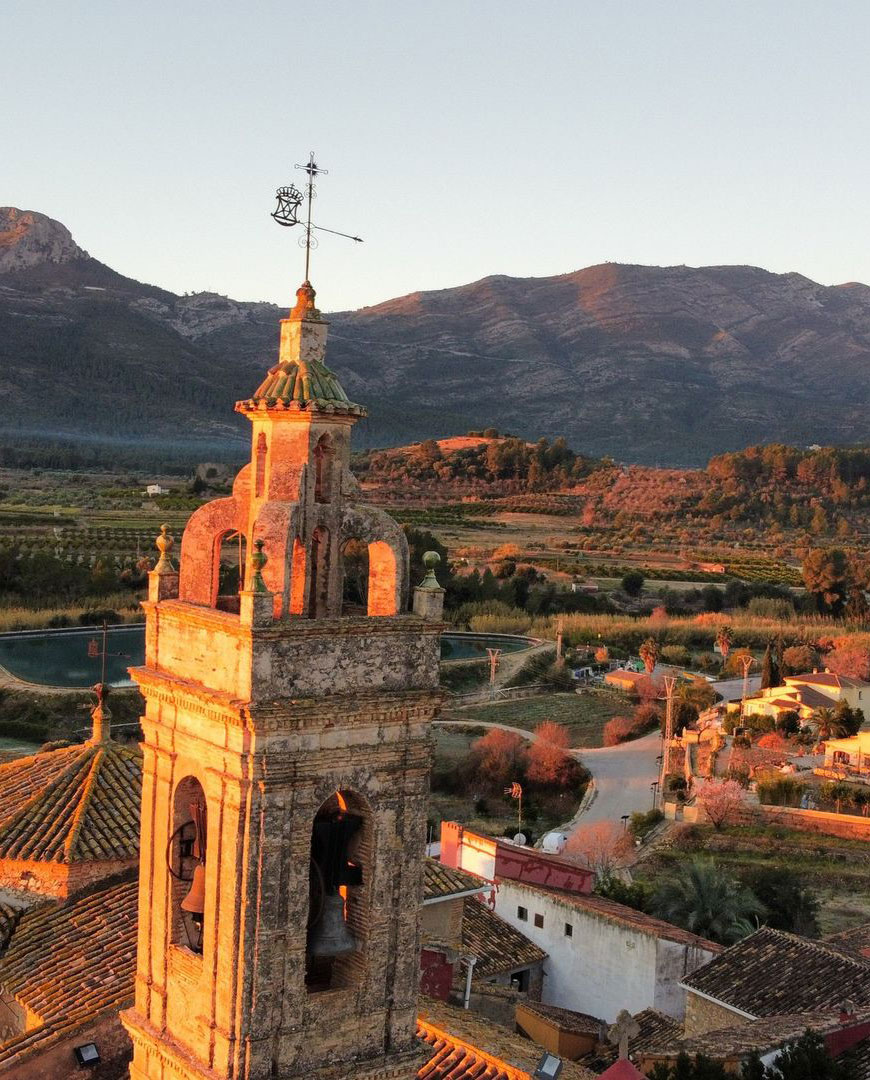
Hermitage of San Juan de la Mosquera from the 18th century. In the past, the Mosquera district housed the estate, farmstead, aljama and barony. The centre of the village was the church, now the hermitage of San Juan, around which the streets were scattered with the thirty houses that existed in 1577, the various riu raus, the threshing floor, the tahona, the baking oven, the oil mill and the other agricultural elements that made it up. In 1609 it was totally depopulated, coinciding with the expulsion of the Arabs. Nowadays, there are only a few scattered houses that have been converted into summer dwellings and the Hermitage of San Juan itself. This was ordered to be built by the archbishop San Juan de Ribera and has been preserved to this day in its original form and integrity, with only the missing bell tower.
Ermita del Calvario: It is dedicated to the Virgen del Calvario and its construction was carried out between 1952 and 1954. All the inhabitants of the municipality contributed to its construction, voluntarily, free of charge and spontaneously.
voluntarily, free of charge and spontaneously. Subsequently, in 1956, the construction of the sacristy began, and the work was completed in May of the following year, thanks to the economic contribution of the whole town and the selfless work of the inhabitants. The sacristy was the site of the holy Christ of the Thirst, which presides over it. It is the work of Francisco Navarro Soriano and is a work of remarkable artistic value for its anatomical precision, for the exemption of all impasto and paint and for the vigorous and dramatic attitude with which the Lord is represented.
Sport is intimately linked to nature, especially to mountain sports such as hiking, paragliding, cycling, etc. Moreover, as the weather is exceptional, these sports can be practised at any time of the year.
Medieval Tower: The inhabitants of Alcalalí were victims of frequent attacks by pirates and bandits.
bandits. To protect himself from these invasions, Mosen Pedro de Castellví, sovereign of Alcalalí and Jalón, ordered the construction, at the end of the 14th and beginning of the 15th century, of a tower measuring 6x8 m. and 18 m. high, to serve as a watchtower and last bastion of defence.
Don Eiximen Ruiz de Lihori built a palace-residence next to the tower in 1600, connecting both buildings with an elevated bridge. In 1833, the roof of the palace was repaired and the lookout platform of the tower was completely closed. The Town Council of Alcalalí acquired the tower in 1992 and in 1995 it was completely restored and the top floor was re-established as a lookout point.
It currently conserves its original structure and is divided into 5 floors. The Medieval Tower of Alcalalí is registered in the Register of Assets of Cultural Interest of the Spanish Historical Heritage with the category of Monument.
In 2006, conservation, restoration and interpretation work was carried out on the graffiti and engravings on the tower. These are of great historical-artistic interest and are undoubtedly of great expressive richness. These manifestations of man, made during the 16th, 17th and 18th centuries, give us a deeper understanding of the habits, customs, feelings and sensations of the people who inhabited the lands of Alcalalí. We can see various calendars, a swordsman, people fishing and rowing, birds and exotic animals, a shotgun, daggers, crosses, a religious image and various boats. The depiction of boats in an inland village such as Alcalalí is very interesting. It is thought that these engravings were made by sailors who may have stayed for a time in the Tower.
On the top floor of the Tower is the Mirador. From here you can enjoy magnificent panoramic views of the Vall de Pop. We can see the Coll de Rates, the neighbouring village of Parcent with its bell tower, Mount Pop de Murla, where the last battle between the Moors and Christians took place in 1609, Mount Seguili and the town of Xaló.
Church of the Natividad de Nuestra Señora: The first Catholic church built in Alcalalí, as far as is known, was
that we know of, was built in 1577. Later, in 1582, the second church was built and between 1768 and 1808, the Parish Church of the Nativity of Our Lady was largely destroyed during the Civil War. Many neighbours hid valuable objects in their houses, which were returned at the end of the war. Reconstruction work was completed in 1961.
The church contains images of important historical and artistic value, such as the image of the Cristo de la Salud. You can also visit the Parish Museum, which displays old chasubles, the Lihori family's clothing and, among other objects of interest, a library with the history of the church.
CAVE ART:
The wall paintings of recent prehistory, located in the Mediterranean Arc of eastern Spain, are the largest collection of rock art in Europe and constitute an exceptional image of human life in a fundamental period of the cultural evolution of mankind. In addition to their exclusivity and fragility, they are of great importance because they are embedded in a humanised landscape, but of high ecological value, and because of their value as a documentary artistic testimony of the period.
The Rock Art of the Mediterranean Arc of the Iberian Peninsula is made up of more than 750 locations in rock shelters and cliffs in which figurative graphics or images have been found, ranging from simple geometric traces to scenes representing animals and human beings in ritual compositions of hunting, gathering, dance or war.
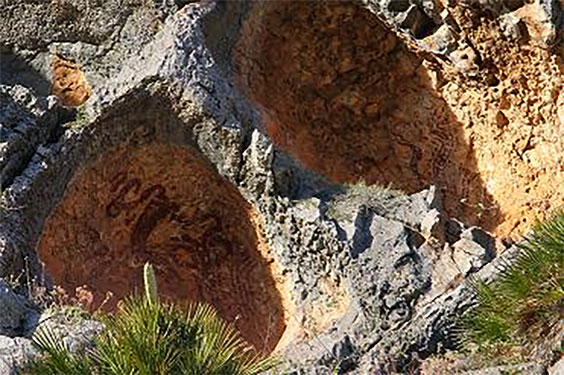
The cave painting found in the Siguili shelter consists of two figures. This painting has been classified as anthropomorphic schematic rock art.
In 1985, the Cave Art of the Mediterranean Arc, which includes the cave painting located in the Siguili shelter, was declared an Asset of Cultural Interest. It was subsequently declared a World Heritage Site by UNESCO. The Consell de la Generalitat, on 15 October (DOCV num. 6380 of 20.10.2010) agreed to approve the list of caves, shelters and places with rock art in the Valencian Community and their inscription in the Inventory of Valencian Cultural Heritage, with the category of Archaeological Areas. This list includes the cave painting in the Penyes dels Seguers at the Siguili shelter.
GASTRONOMIC ALCALALI
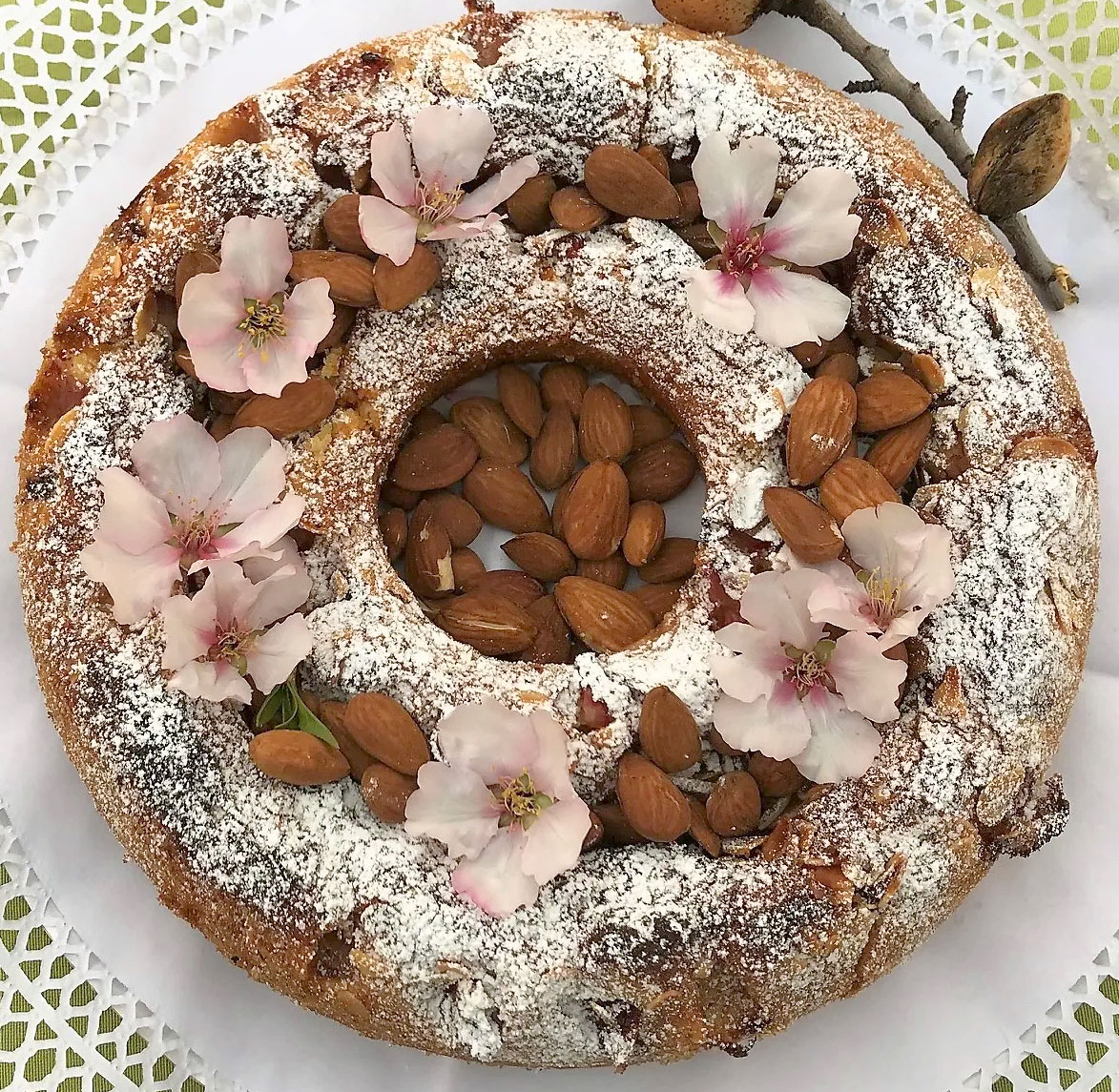
In addition to the scenery and culture, the gastronomy is another of the great attractions for visitors to Alcalalí. An excellent variety of dishes with a local flavour, from cous-cous to cocas, make up the recipe book of our town. You can taste some excellent dishes in any of the bars and restaurants that you will find in this list.